
 Key Takeaways
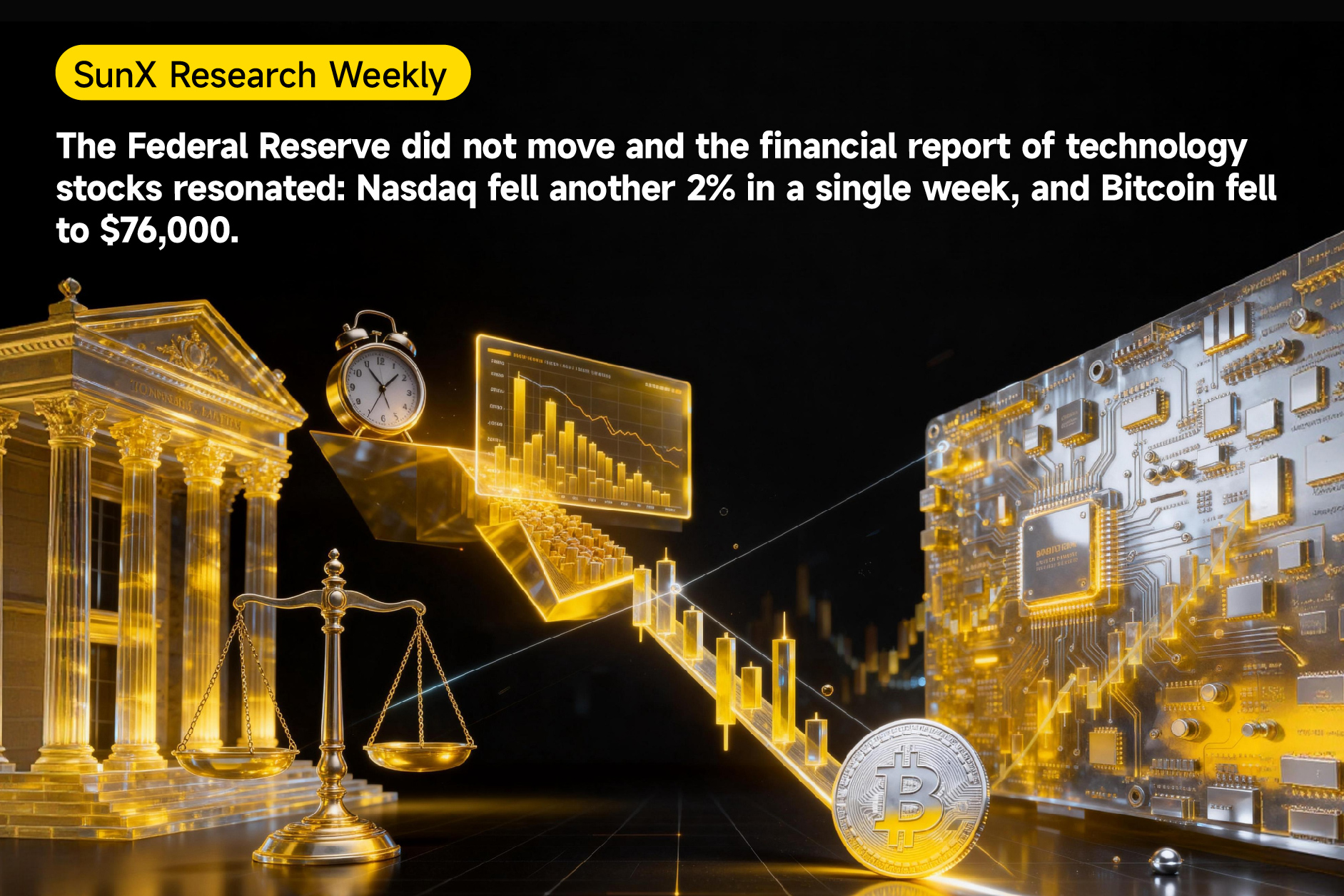
This week's dominant global market narrative was the simultaneous validation of two themes: "the Fed holding rates steady" and "continued pressure on technology stock weightings." On 28 October, the FOMC voted 10–2 to maintain the federal funds target range at 3.75%–4.00%, with Lisa Cook and Beth Hammack dissenting in favour of a further 25 basis point hike. The S&P 500 fell approximately 0.57% over the week to 7,580.07 points, with a single-day decline of 1.82% on Friday — its worst session since June. The Nasdaq fell approximately 2.00% to 25,437 points, down 2.86% on Friday; the Dow fell approximately 0.85% to 51,770 points; and the Russell 2000 rose approximately 1.29%. Alphabet fell 12.64% on Thursday — one of its largest single-day declines since listing — while Intel fell approximately 28.6% on Friday. The 10-year US Treasury yield retreated to approximately 4.93% over the week. Crypto markets weakened in tandem: Bitcoin fell from around US$81,000 at the start of the week to approximately US$76,450 on Friday, while Ethereum broke below US$2,300. Spot Bitcoin ETFs experienced sharp volatility this week, with net outflows of approximately US$643 million on Friday alone — one of the largest single-day outflows since June — while news of a hack on Binance's hot wallet, resulting in losses of approximately US$6.36 billion, further amplified the retreat in risk appetite. Below is SunX Research's complete review of this week's TradFi and crypto markets.
I. Macroeconomic and Traditional Finance: FOMC Holds Rates Steady, but Tech Earnings and Capex Concerns Dominate the Sell-Off
The most important macro event for US equities this week was the FOMC meeting on 27–28 October. The committee voted 10–2 to maintain the federal funds target range at 3.75%–4.00%, in line with broad market expectations. Lisa Cook and Beth Hammack dissented, advocating a further 25 basis point hike. The statement noted that economic activity is expanding at a strong pace, productivity growth is robust and capital investment is solid, but inflation remains elevated; the committee will accumulate further information to determine the policy stance needed to ensure inflation returns to the 2% target in a timely manner. Chair Warsh emphasised at the press conference that additional data before December will help inform the next step. Market pricing for a December hike remains elevated.
Index reactions to the meeting itself were limited; what truly drove this week's price action was the earnings and capex narrative surrounding technology stock weightings. As of the close on 30 October, the S&P 500 stood at 7,580.07 points, down approximately 0.57% for the week; the Nasdaq Composite stood at 25,437 points, down approximately 2.00%; the Dow stood at 51,770.31 points, down approximately 0.85%; and the Russell 2000 rose approximately 1.29%. On Friday, the S&P 500 fell 1.82% in a single session and the Nasdaq fell 2.86% — a relatively large drawdown in recent weeks. Alphabet fell 12.64% on Thursday — one of its largest single-day declines since its 2004 listing — while Intel fell approximately 28.6% on Friday. The equal-weighted S&P 500 outperformed the market-cap-weighted index this week, indicating that capital continued to rotate away from mega-cap technology stocks into the broader market.
In bonds and commodities, the 10-year US Treasury yield retreated from approximately 4.99% to approximately 4.93% over the week, closing at 4.929% on Friday. The dollar index stood at approximately 101.88–101.96, broadly flat for the week. Crude oil remained elevated, with Brent at approximately US$117.64 and WTI at approximately US$104.12. Gold remained under pressure, with December gold futures closing at approximately US$3,899 on Friday and spot gold breaking below US$3,900, a single-day decline of approximately 3.3%. Elevated inflation, oil prices that have not fallen meaningfully, and doubts over the path to capex recovery in technology stocks together constitute the current pricing backdrop for risk assets.
For crypto traders, the key focus next week is November's employment and inflation data, together with the market's final pricing of whether the FOMC will hike in December. If the 10-year yield breaks back above 5%, Bitcoin — which has already retreated — will face greater pressure; if yields remain below 4.90% and the technology sell-off moderates, prices have room to consolidate in the current area.
II. Crypto Market Microstructure: Bitcoin Breaks Below US$80,000, with Huge ETF Outflows on Friday Compounding the Binance Incident
As of 1 November, Bitcoin was trading around US$76,000–78,000. The week's path can be divided into three phases. The first was the rebound attempt from the start of the week through Wednesday: prices recovered from around US$79,000–81,000 and briefly stabilised after the FOMC held rates steady. The second was the accelerated decline from Thursday to Friday: the sell-off triggered by technology earnings spread to crypto markets, with prices breaking below US$80,000. The third was Friday's further decline: spot Bitcoin ETFs saw net outflows of approximately US$643 million in a single day (one of the largest single-day outflows since June), with prices touching a low of approximately US$76,450 before oscillating in the US$76,000–77,000 range over the weekend. Ethereum weakened in tandem, breaking below US$2,300 to around US$2,270. Solana, XRP and other major assets all recorded notable drawdowns.
Fund flows were the hardest data of the week. According to statistics from platforms including SoSoValue, spot Bitcoin ETFs saw net inflows in the first half of the week, with single-day inflows reaching several hundred million dollars around Wednesday; however, Friday saw net outflows of approximately US$643 million, of which IBIT accounted for approximately US$234 million, FBTC approximately US$201 million and ARKB approximately US$130 million. Cumulative weekly flows turned to net outflows or narrowed sharply as a result of Friday's heavy redemptions. Spot Ethereum ETFs continued to see net outflows this week, in the region of US$400–600 million. Forced liquidations were amplified during the rapid price decline, with long positions bearing the brunt of the cleansing.
In terms of price structure, US$80,000 has shifted from support to near-term resistance, US$78,000 is the bull-bear inflection zone, and US$76,000–76,500 is the support area tested this week. If prices break below US$76,000 and ETFs continue to see net outflows, the market may retest US$72,000–74,000; if prices can hold above US$78,000 and IBIT resumes net inflows, there is scope to challenge US$80,000–82,000 once again. In contrast to the relative resilience of small-cap stocks, Bitcoin continued this week to track technology stock weightings and risk appetite rather than defensive sectors.
III. In-Depth Industry Analysis: The Binance Security Incident and ETF Outflows Are Together Re-Testing the Resilience of the Institutional Channel
Beyond the macro and technology-stock linkage, crypto markets also experienced a major security incident this week. According to multiple reports, on the evening of 29 October, a North Korea-linked hacker group attacked Binance's hot wallet, stealing approximately US$6.36 billion across 10 chains in around 20 minutes — one of the largest cryptocurrency thefts to date. The incident did not directly trigger spot ETF redemptions, but it significantly amplified the market's retreat in risk appetite, exposing already-fragile crypto assets to additional selling pressure amid the technology sell-off. For institutional capital, this was a stress test of custody, exchange security and the resilience of on-chain infrastructure.
Spot ETF flows were highly volatile this week. Net inflows in the first half of the week showed that some institutions were still using the price pullback to allocate; Friday's huge outflows demonstrated that redemption speeds accelerate markedly when a sharp technology correction coincides with a security incident. IBIT remains the largest liquidity product, but it too saw significant redemptions on Friday, showing that even the lowest-fee, most liquid product cannot be fully immune when risk appetite contracts sharply. The continued net outflows from Ethereum ETFs further reinforce a structure in which capital concentrates in core Bitcoin exposure while overall risk budgets contract.
In contrast to ETFs, the pace of corporate treasuries and long-term holders differs. Previous increases by companies such as Strategy do not track single-week ETF flows. This week, ETFs saw sharp swings while corporate treasuries did not show corresponding large-scale reductions, indicating that the medium-term floor is still supported by balance-sheet buyers, but that weekly direction has been handed back to fund flows, macro data and sudden events. For professional capital, institutionalisation does not equal one-way inflows: it encompasses both subscriptions and redemptions, and redemption speeds accelerate significantly when multiple pressures coincide.
SunX Research's assessment: the market has moved from the question of "whether macro headwinds have been digested" to the stage of "whether the technology capex narrative, security incidents and high rates can coexist." If next week sees a moderation in the technology sell-off, a return to net inflows for ETFs, and the market digesting the security incident, there is scope — after consolidation at US$76,000–78,000 — to challenge US$80,000 again. If ETFs continue to see net outflows or security concerns spread, then US$76,000 will prove to be merely a阶段性 low rather than the start of a trend reversal.
IV. SunX Trading Strategy Guide: Shift Positioning from "Betting on an FOMC Tailwind" to "Managing Drawdowns Under Multiple Overlapping Risks"
In a window where the 10-year US Treasury yield is near 4.93%, technology stocks are down 2% for the week and Bitcoin has just broken below US$80,000, the win rate for chasing longs with high leverage or blindly bottom-fishing at US$76,000 is low. For SunX high-net-worth users and professional traders, the more appropriate framework this week is to "manage volatility with futures, use IBIT flows for confirmation, and preserve ammunition with stablecoin yields."
First, build defensive trades around US$76,000–80,000 rather than making one-sided bets on a rebound. Investors holding spot can use SunX futures to establish a small hedge above US$79,000–80,000 to guard against gap-down drawdowns if the technology sell-off expands or ETFs continue to see net outflows; if prices retrace to US$76,000–76,500 and IBIT remains relatively resilient, then consider scaling down the short hedge in tranches. Before US$78,000 is reclaimed, this week's technical stabilisation should not be treated as the starting point of a trend recovery. SunX's depth and matching speed are well suited to handling this kind of cross-time-zone volatility — "following US equities by day, and ETF flows and sudden events by night."
Second, reduce long-tail exposure unrelated to institutional flows and place idle capital in a verifiable yield layer. What showed genuine relative resilience this week were certain small-cap stocks and traditional financial assets corresponding to equal-weighted indices, as well as IBIT's relatively better liquidity. We recommend reducing pure-narrative altcoin positions, converting capital into USDT or USDC, and transferring it to SunX Earn to lock in relatively steady passive yields in an environment where US Treasuries yield around 5%, while retaining the flexibility to switch back to spot or hedge positions at any time. After security incidents and huge ETF outflows, daily volatility will be amplified; transparent, redeemable platform yields are more valuable for allocation than high APYs of unknown origin.
Third, narrow next week's watchlist to three sets of actionable data: whether spot Bitcoin ETFs, especially IBIT, return to net inflows; whether technology stock weightings stop their consecutive sell-off; and whether the 10-year US Treasury yield can remain below 4.95%. The first two determine beta direction, while the third determines macro liquidity expectations. If all three improve simultaneously, there is still scope to challenge US$80,000; if only prices rebound while ETFs continue to see outflows, the rebound should be treated as a window to reduce positions.
SunX Research will continue to track the three main threads of US Treasuries, ETFs and security incidents, helping you capture structural opportunities for compounding in a high-rate cycle rather than being led astray by single-day technology rebounds or single-day ETF outflows.
(Disclaimer: The macroeconomic data, US equity indices, bond yields, commodity prices and crypto market indicators cited in this article are for research discussion and trend analysis only and do not constitute any financial, legal or investment advice. Digital assets and leveraged products are extremely volatile; please make prudent decisions based on your own risk tolerance and strictly enforce risk controls.)
Comments
0 comments
Please sign in to leave a comment.